Home/Stories and news/Historical thinking for critically shaping the future
Historical thinking for critically shaping the future
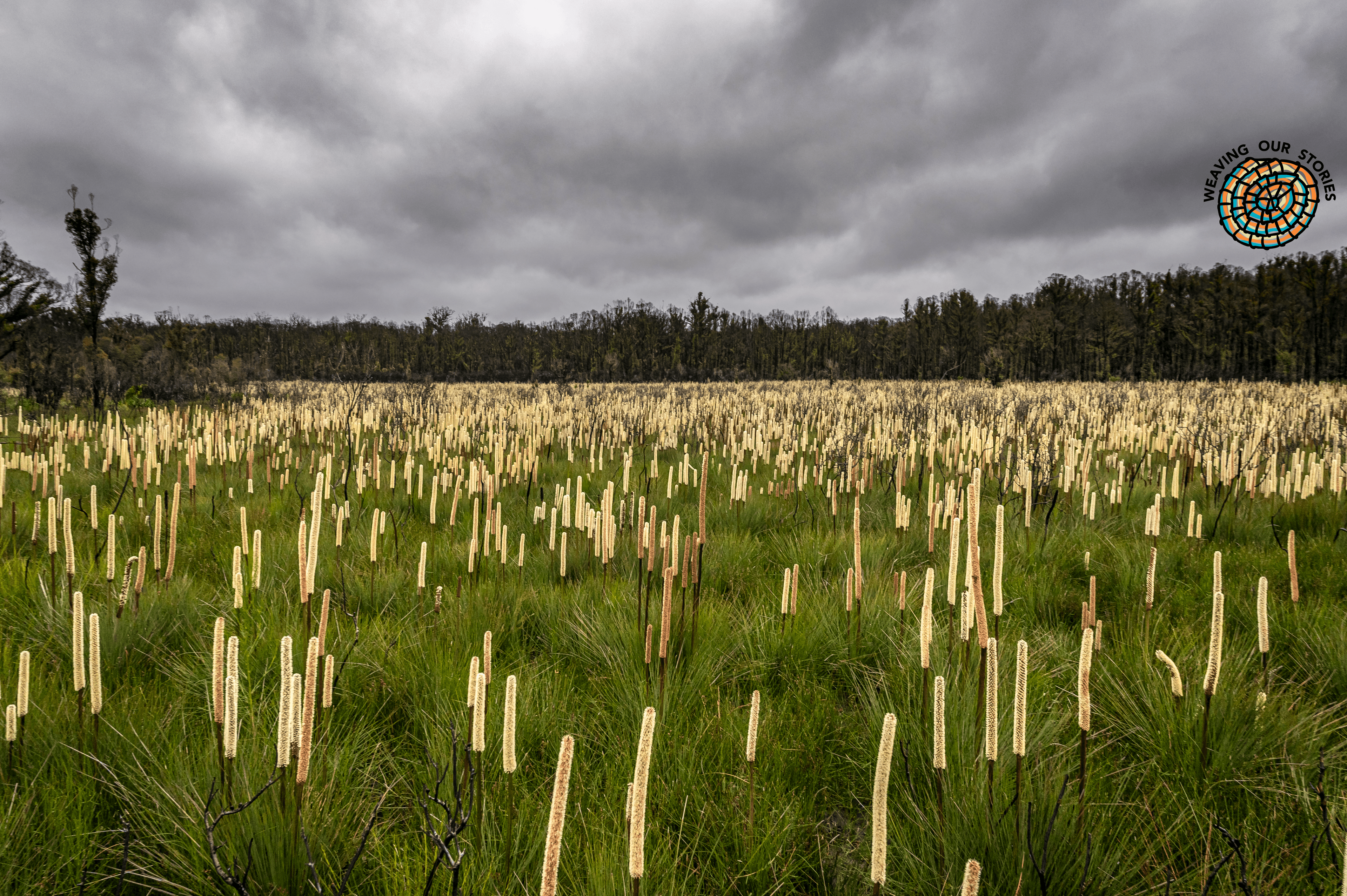
Flowering Grass Trees, Mallacoota, Gunai/Kurnai country. Tiffany Garvie. Source: Ngarrngga. © Tiffany Garvie 2023. Used under licence. Featuring Weaving our Stories logo designed by Emily Gittins.
The Shaping Australia’s Future position paper offers educators opportunities to understand and explore how historical thinking and knowledge can enable just futures to be collectively made. Education is often a future focused activity, preoccupied with growing individual and collective knowledge, capacities and skills, underpinned by dominant notions of expansion and progress.
While education shouldn’t be opposed to individual and collective knowledge and skill building, it is important to consider how colonial and capitalist logics may underpin these notions and what possibilities there are for alternative logics to guide educational practices and relations. This is why historical inquiry and engagement are so necessary for shaping futures that are not constrained and encumbered by colonial-capitalist impulses.
As researchers based in the United Kingdom have argued in their UNESCO background paper ‘Learning with the Past: Racism, Education and Reparative Futures’, ‘learning with the past – particularly past struggles over the future – is crucial…for holding open education as a mode of critique, rather than allowing it to sustain systems of domination’ (Sriprakash et al, 2020, p.3). This points to how even well-intentioned education may contribute to upholding systems of domination if critical awareness of structural injustices and histories of domination are not heeded.
As highlighted in the Shaping Australia’s Future position paper, ‘the inclusion of Aboriginal and Torres Strait Islander histories and cultures in Australian education is not merely a matter of preserving cultural heritage but a vital step towards creating a more inclusive, equitable and harmonious society’ (p. 1). Indigenous knowledge and history matters for all of us, therefore, and for our collective future.
Shaping Australia’s Future makes four calls to action, directed at educators, education leaders, governments, policy makers and the Australian public. These calls urge critical examination and evaluation, increased funding and resources, policy development and widespread learning through public education opportunities. Below I offer some suggestions for engaging these calls to action.
Critical educators are collaborative inquirers and connectors
The position paper calls on educators, leaders and institutions to critically examine current curricula, practices and cultures to locate stereotypes, marginalisation and oppression and to find opportunities for engagement with Aboriginal and Torres Strait Islander histories, cultures and knowledges. Brazilian education theorist, Paulo Freire, argued that solidarity between the oppressed and oppressors is required to struggle towards justice based on the humanisation of all. This offers an important way of thinking about how we go about this work.
First, we need to be clear sighted about our goal: justice and the humanisation of all. This means educators must help students to see how critical engagement may engender some uncomfortable feelings but these help learn to listen and to collectively redefine how we want to live so that there is room for wide knowledge building, understanding, care and connection.
Educators may find it helpful to think about how they can be in solidarity with their students, learning alongside them and asking questions with them. This positions educators as co-inquirers, able to steer students in helpful directions but not be knowledge holders (except of course if they are a First Nations teacher and have a different role to play). Al Fricker, Dja dja Wurrung education researcher has argued that solidarity must drive work towards Indigenous justice and climate justice (which are connected).
Planning teaching and learning activities through a lens of solidarity may help educators work towards the goal of justice. They might ask, for example: How can I be in solidarity with my students as we explore stereotypes and how to reshape them for justice and humanisation? How can we learn about climate change in solidarity with Country and guided by Indigenous knowledge?
Second, we need to understand our histories in order to make just futures. Becoming historically aware is part of engaging in the truth-telling (and truth-listening) process. The National Indigenous Youth Education Coalition asks school principals and leaders to take a pledge to ‘Learn Our Truth’. Taking this pledge helps your community to make truth-listening and learning the history of Aboriginal and Torres Strait Islander sovereignty and resistance a priority in your school.
There are many places that teachers and leaders can turn to for curriculum resources to help support their planning. Of course the Ngarrngga itself has created and collated many helpful curriculum resources that you can search and filter for year level, learning areas and elements. The Truth-telling Pedagogies Lab also has resources that can help guide teacher practice.
Powerful inclusive policy addresses structural injustices
The position paper calls on governments and policy makers to properly fund and resource initiatives that pursue Indigenous justice and to prioritise meaningful engagement and integration of Aboriginal and Torres Strait Islander histories, cultures and knowledges.
Policy makers should also consider the structural barriers and injustices that impede these efforts of engagement and integration. For example, First Nations students continue to face disproportionate rates of school exclusion and experiences of racism in schools. Policy makers should work with students, families and communities to ensure schools are safe places for First Nations communities to engage and participate. Learning from both historical and contemporary examples of strong and safe First Nations education is important.
Aboriginal and Torres Strait Islander educators are numerous
Another call to action in the position paper is for all Australians to engage and learn about the histories, cultures and knowledges of Aboriginal and Torres Strait Islander people. And happily, there are plenty of opportunities to learn from First Nations people and communities as Aboriginal and Torres Strait Islander educators are numerous. Indigenous people have been storytellers for thousands of years and their stories, poems and knowledge is collected in a vast literature, including texts published by Indigenous owned and operated, Magabala books. Stories, culture and knowledge are also shared through art, dance, song, film, TV, and theatre.
You can learn about and eat Aboriginal and Torres Strait Islander food and cooking, and Indigenous people and communities are continuing and returning to food growing and cultivation practices and land management techniques, which keeps Country healthy and strong for generations to come. Indigenous owned and operated media reports on issues important to First Nations communities, and public art reminds us of First Nations connection to Country and community, helping to decolonise common places.
There are many ways for us all to answer these calls to action and the links and suggestions I have shared here are just a starting point. Importantly, learning with and about First Nations knowledge and experiences requires historical understanding, humility and collective care. If we make a mistake, let’s address it and learn from it. This helps us grow collectively and shape sustaining and sustainable futures for all.
Contributor Bio
A/Prof Sophie Rudolph
Sophie Rudolph is an Associate Professor in the Faculty of Education at the University of Melbourne. She researches the educational implications of settler colonialism and is engaged with a range of communities in efforts towards transforming systems of oppression.
Learn more about A/Prof Sophie Rudolph here.