Home/Curriculum resources/Indigenous Ecological Knowledge and celestial objects/Resource 2: Exploring the Celestial Emu case study
Learning Areas:
Science, English, Mathematics
Year levels:
Level 5, Level 6
Resource 2: Exploring the Celestial Emu case study
This activity is a part of the Indigenous Ecological Knowledge and celestial objects resource.
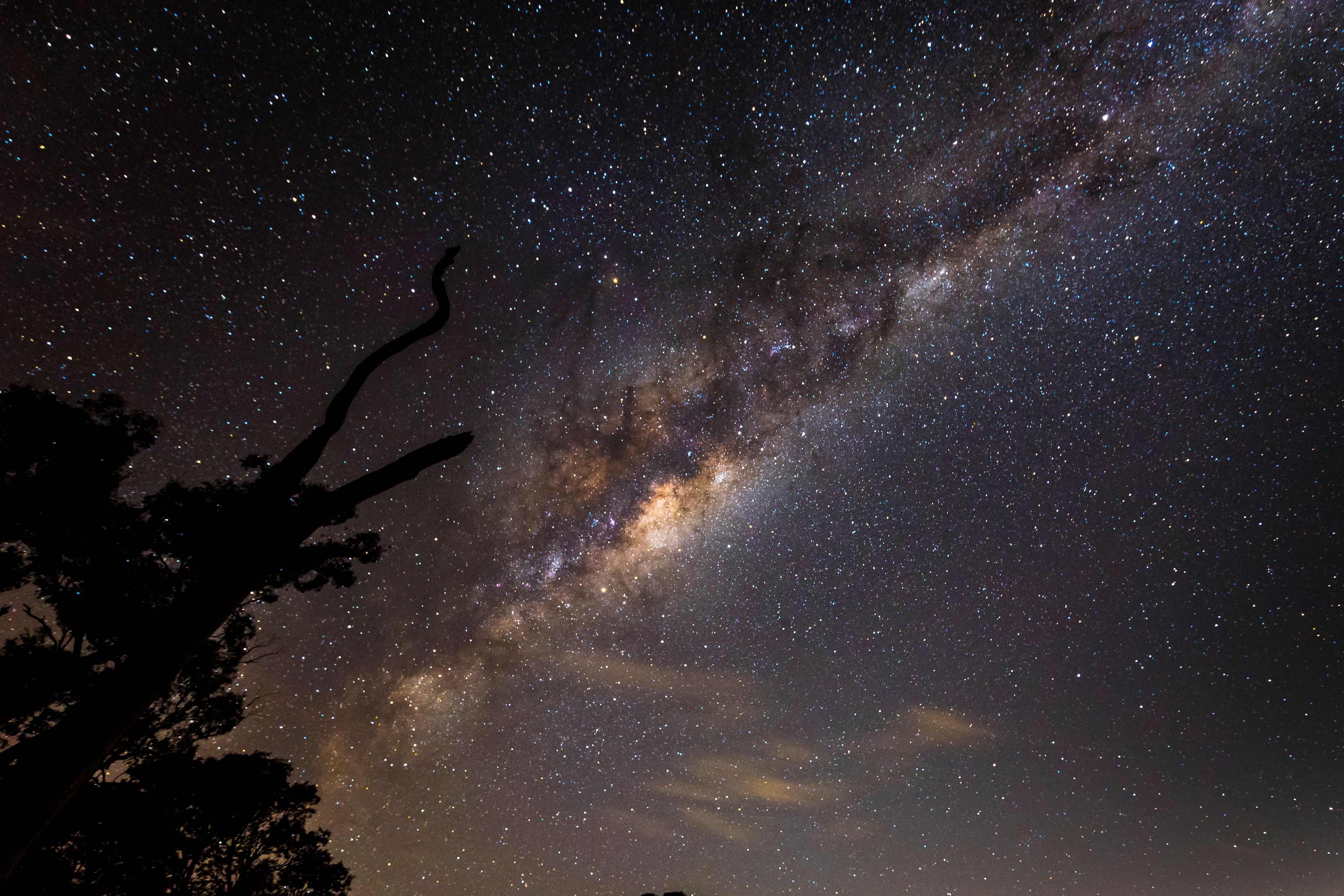
Black Tree and Night Sky, Diggers Rest, Wurundjeri Country. Tiffany Garvie. Source: Ngarrngga. © Tiffany Garvie 2023. Used under licence.

Resource 2: Exploring the Case Study Celestial Emu
The following multimodal resources and possibilities outline how to support student engagement and understanding of the Celestial Emu, incorporating Aboriginal and Torres Strait Islander perspectives. These resources will help students explore dark constellations, understand different ways of viewing the sky, and appreciate the rich history of Aboriginal astronomy.
Video Clips
Clip 1: Associate Professor Duane Hamacher Dark constellations - different ways of viewing the sky
Clip 2: Associate Professor Duane Hamacher The Emu in the sky
Clip 3: Emu in the Sky AusEarthEd (YouTube)
Clip 4: Cultural Astronomy Peter Swanton Young Stars (YouTube)
Clip 5: Indigenous Astronomy V2.5 Interconnectedness II - The Emu in the Sky (YouTube)
Clip 6: 65,000 yrs- The great history of Australian Aboriginal Astronomy – Kirsten Banks- TEDxYouth@Sydney
Possibilities for classroom implementation
Multimodal exploration and discussion | Students can engage with the provided clips/videos and texts related to the Celestial Emu. Following this, they can undertake group discussions to share their observations and thoughts. Guided questions can help students reflect on the cultural and scientific aspects presented in the texts. |
Visual representations | Students can create visual representations of the Celestial Emu constellation. This can include drawing, painting, building 3D models using various materials or creating animations. A range of online tools and apps can be used to create animations using code or stop motion, for example: Scratch, ABCya and Stop Motion Animation. They can also create star maps that illustrate the position and movement of the Celestial Emu throughout the year. Students can provide the information that is relevant to each stage and possibly annotate their visual representations. |
Research and presentation | Students can conduct research on the Celestial Emu and its significance in Indigenous cultures. They can use provided fact sheets, texts, and online resources to gather information. The findings can be presented through PowerPoint presentations, posters, or digital storytelling, allowing students to practice their research and presentation skills. |
Writing | Students can engage in various writing activities to deepen their understanding of the Celestial Emu and its significance. Reflective Writing: Students can write reflective pieces about what they have learned from the Celestial Emu. This can include personal reflections on how their understanding of the night sky has changed, as well as the cultural significance of the constellation. Discussion Piece: Students can write a discussion piece on the importance of integrating Indigenous Knowledge into modern scientific education, exploring how these perspectives can enrich their understanding of astronomy. Information Report: Students can write an information report on the Celestial Emu, detailing its significance in Indigenous cultures, its appearance in the night sky, and how it changes throughout the year. Persuasive Writing: Students can write a persuasive essay arguing for the inclusion of Indigenous Astronomical Knowledge in the school curriculum, presenting reasons and evidence to support their viewpoint. Expository Writing: Students can write an expository piece explaining the concept of dark constellations, how they are viewed in Indigenous cultures, and their differences from Western constellations. |
Night-time event | If possible, organise a night sky observation session where students can try to locate star maps. Seek guidance from an Astronomical Society such as the Astronomical Society of Victoria or local astronomer/educator familiar with Indigenous astronomy. Use the Night sky observation task provided. This could also be completed by students at home with their families. |
Excursion | If possible, organise an excursion to a planetarium. |
Mathematical problems | There are three mathematical problem-solving task cards provided exploring data representation, angles and fractions related to the Celestial Emu. |
Science investigation | Students can take a stance on the hypothesis and then undertake various experiments and research activities to collect data. They will analyse and collate their findings, which can be shared through reports, presentations, or infographics. Begin by supporting students to form an opinion around the statement ‘The position of the Celestial Emu reflects the behaviour of a real Emu’. They can choose to agree or disagree. Students can change their standpoint as the gather information throughout the investigation. Possible experiments/engagements Use a star gazing app to locate the constellations that make up the Celestial Emu. This stretches across the Milky Way from the Coalsack Nebula (next to the Southern Cross) - which is the emu’s head - down to the body in the Western constellations of Scorpius and Sagittarius. Use the timing function of the app to view the different stages of the Celestial Emu over a time period. Students can research about the Celestial Emu from the provided resources and the research support card. Share findings: Students can share their findings (report, presentation, video, infographic, etc.) |
Related activities within this resources:
Resource 1: Visible Thinking Routines to explore the Milky way and Celestial Emu
This resource outlines how various thinking routines can be used to support student engagement and understanding of the night sky and constellations, incorporating Aboriginal and Torres Strait Islander perspectives. These routines will help students articulate their prior knowledge, raise questions, and develop a deeper understanding of celestial objects, including Indigenous perspectives on constellations.
Resource 3: Exploring Indigenous Ecological Knowledge and the sky case studies
These multimodal resources are designed to support student engagement and understanding of how Aboriginal and Torres Strait Islander Peoples use celestial objects and events to understand the behaviours of living things. Through five different case studies, students will explore stars and the moon, learn different perspectives on the sky, and find out about the rich history of Aboriginal and Torres Strait Islander astronomy.